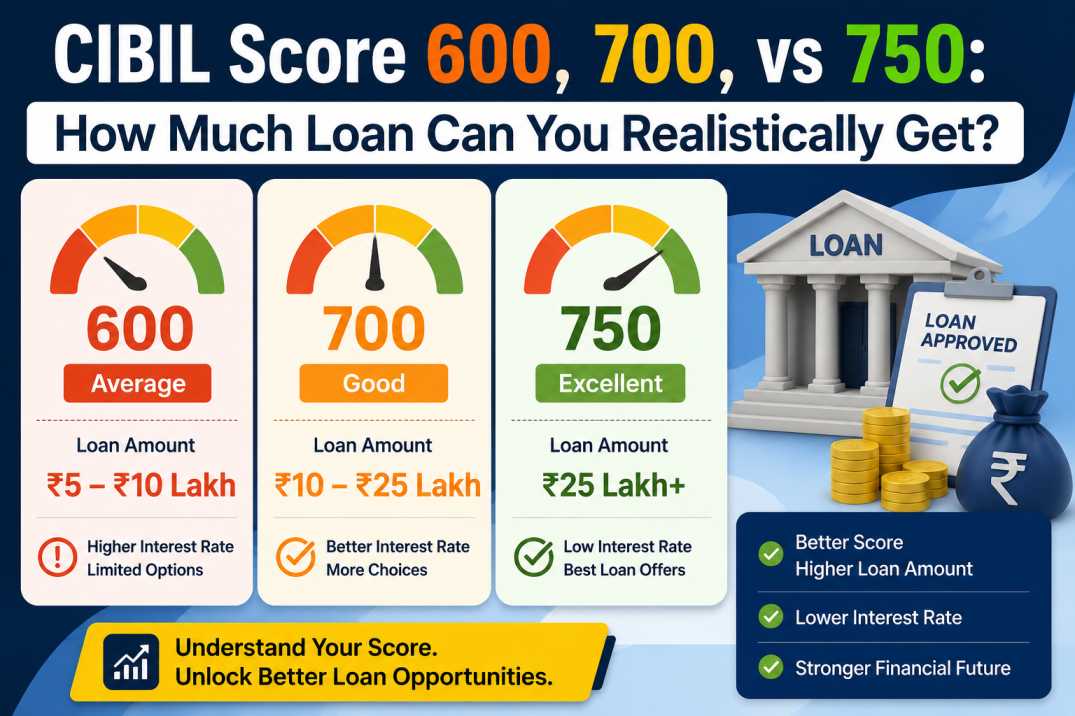
One of the most common questions borrowers ask loan officers is: “My CIBIL score is 600 (or 700, or 750)—how much money will the bank give me?”
Before diving into the numbers, it helps to understand a basic banking truth: Your CIBIL score does not directly decide the exact loan amount—your net income and repayment capacity do.
What your credit score actually dictates is your approval probability, the loan-to-value (LTV) ratio, collateral requirements, and your interest rate. A borrower with a 750 score earning ₹25,000 a month will qualify for a smaller loan than someone with a 680 score earning ₹2,00,000 a month. However, your score defines the maximum limits and terms banks will offer.
Let’s break down realistic loan expectations across the three major credit tiers: 600, 700, and 750+.
1. CIBIL Score 600: High Risk (Borrowing Under Restrictions)
A score of 600 sits in the subprime category. Major public and private banks like SBI, HDFC, or ICICI will generally reject unsecured personal loan applications at this level because their automated underwriting systems flag high credit card balances or past 30+ day defaults.
- Unsecured Personal Loans: You are limited to fintech platforms or NBFCs. Even with a decent salary, expect sanctions between ₹25,000 and ₹1.5 Lakh, paired with interest rates reaching 20% to 32%.
- Home & Vehicle Loans: Public sector banks typically reject these. However, specialized housing finance companies (HFCs) may approve loans under affordable housing schemes, but they will demand a higher down payment (30% to 40% margin) and elevated interest rates (11% to 14%).
- The Best Alternative: At 600, your most viable path to a larger sanction is a Secured Loan—such as a Gold Loan or Loan Against Fixed Deposit (FD)—where the score matters significantly less.
2. CIBIL Score 700: Moderate Risk (The Acceptable Benchmark)
A score of 700 places you in an acceptable range. You will pass the initial eligibility filter for most lenders, though you will not get prime discount pricing.
- Personal Loans: You can secure loans from ₹2 Lakh to ₹7 Lakh, provided your income supports the monthly EMI. Lenders will usually cap your Fixed Obligation to Income Ratio (FOIR) at around 45% to 50%.
- Home Loans: You can qualify for major home loan amounts (e.g., ₹40 Lakh to ₹80 Lakh or more), but lenders will price in a moderate risk premium of 0.35% to 0.75% above their lowest advertised rates.
- Processing Time: Manual documentation checks are common here. Banks will verify bank statements closely to confirm you have no bounced NACH debits or cheque returns over the past 6 months.
3. CIBIL Score 750+: Low Risk (Prime Tier & Maximum Sanctions)
According to official data from TransUnion CIBIL, over 80% of all loans and credit cards sanctioned by Indian institutions go to individuals with scores of 750 or higher.
- Unsecured Personal Loans: You can unlock maximum borrowing limits ranging from ₹10 Lakh up to ₹40 Lakh+ without any collateral, often via instant, paperless disbursement.
- Home Loans: You become eligible for benchmark-linked interest rates (the lowest published floor rate on portals like SBI Home Loans), along with full Loan-to-Value (LTV) ratios of up to 80%–90% for eligible properties.
- Higher FOIR Flexibility: Banks will often permit your total EMI obligations to reach up to 60%–65% of your net monthly income because your repayment history demonstrates strong financial discipline.
The Secret Formula: How Banks Actually Calculate the Final Amount
Even if your CIBIL score is 800, banks won’t issue an unlimited loan. They determine the sanction figure using the FOIR (Fixed Obligation to Income Ratio), regulated by prudent lending directives from the Reserve Bank of India (RBI):
Practical Example:
Suppose your monthly in-hand salary is ₹60,000, and you currently pay a car loan EMI of ₹8,000.
- At CIBIL 600: Bank applies a strict 40% FOIR (₹24,000 max EMI limit). Subtracting your ₹8,000 car EMI leaves ₹16,000 max EMI capacity. At high interest rates (20%), this yields a personal loan of only about ₹3.5 Lakh to ₹4 Lakh over 3 years.
- At CIBIL 750+: Bank permits a 60% FOIR (₹36,000 max EMI limit). Subtracting your ₹8,000 car EMI leaves ₹28,000 max EMI capacity. At prime interest rates (10.5%), this allows for a personal loan sanction of roughly ₹11 Lakh to ₹12 Lakh over 5 years.
Actionable Next Steps
If your score is hovering around 600–650, avoid applying repeatedly to multiple banks. Every hard rejection logs an inquiry, dragging your score down further. Instead:
- Pay down your revolving credit card balances below 30% utilization.
- Settle any outstanding overdue accounts or old disputes.
- Wait 4 to 6 months to allow your score to transition toward 720+ before submitting fresh applications.