
Welcome to WordPress. This is your first post. Edit or delete it, then start writing!
Blog
-

The Ultimate Guide to the Home Loan Process & Interest Rates in India (2026)
Buying your dream home is one of the biggest financial decisions you will ever make. But before you get the keys to your new house, you have to navigate the maze of banking approvals, legal checks, and fluctuating interest rates. A minor mistake in understanding the Home Loan Process can delay your purchase or lock you into a highly expensive EMI for the next 20 years.

In this guide, we break down the step-by-step process of securing a home loan in India and provide a realistic look at current interest rates to help you save lakhs in interest.
Step-by-Step Home Loan Process
Banks are highly cautious when lending huge amounts. Here is the exact 5-step journey your application goes through:
- Application & Document Submission: You submit your basic KYC, income proof (Salary slips/ITRs), and bank statements for the last 6 months. Your CIBIL Score is checked immediately. You need a score of 750+ for the best rates.
- Processing & Personal Verification: The bank charges a non-refundable processing fee (usually 0.25% to 0.50% of the loan amount). A bank representative may visit your office and current residence to verify your profile.
- Sanction Letter Issuance: Based on your income, the bank issues a Sanction Letter stating the maximum loan amount they are willing to offer, the interest rate, and the tenure. Note: This is not the final disbursement.
- Legal & Technical Verification: This is the most crucial step. The bank’s lawyers will check the property’s title chain to ensure there are no legal disputes. Simultaneously, technical evaluators visit the property to estimate its fair market value. The bank will only fund 80% to 90% of this technical value.
- Disbursement: Once everything is clear, you sign the final loan agreement. The bank issues a demand draft or transfers the amount directly to the builder or seller.
Current Home Loan Interest Rates (2026 Benchmarks)
Home loan rates are closely tied to the Reserve Bank of India’s (RBI) Repo Rate. Currently, most banks offer External Benchmark Linked Rates (EBLR). Let’s look at the baseline floating rates for salaried individuals with excellent credit scores.
Top Banks: Floating Interest Rates Comparison
SBI (State Bank of India) ~ 8.40% p.a.Lowest Rates for 750+ CIBILHDFC Bank ~ 8.50% p.a.Fast ProcessingICICI Bank ~ 8.75% p.a.Great for Private Sector EmployeesAxis Bank ~ 8.75% p.a.Flexible Tenure OptionsFixed vs. Floating Interest Rates: What to Choose?
When finalizing your loan, you will be offered two choices:
- Floating Rate: This rate moves up or down based on RBI policies. Recommended for 95% of buyers because it is generally 1% to 2% cheaper than fixed rates, and RBI rules mandate zero prepayment penalty on floating rate loans.
- Fixed Rate: The interest remains locked for the entire tenure. Only choose this if rates are historically low and you want 100% predictable EMIs, but be prepared for hefty prepayment penalties if you try to close the loan early.
Pro Tips to Save Money on Your Home Loan
1. Co-Apply with Your Wife / Mother: Most top banks in India offer a special concession of 0.05% to 0.10% on the interest rate if the first applicant or co-applicant is a woman. Over 20 years, this small discount saves lakhs of rupees.
2. The 5% Prepayment Magic: Try to prepay just 5% of your outstanding principal every year. This simple habit will reduce a 20-year home loan tenure to just 12 years! -

How Much Money is Needed for Child Education in India?
As Indian parents, we all dream of providing the absolute best education for our children. But there is a silent budget killer that most of us completely underestimate: Education Inflation. While general inflation hovers around 5% to 6%, the cost of higher education in India is galloping at an alarming 10% to 12% annually.
If you are planning your toddler’s future based on today’s fee structures, you are in for a massive shock. Because of compounding inflation, by the time your 3-year-old is ready for college, those fees will have multiplied by nearly four times.
The Brutal Reality of Education Inflation
According to data tracked by the Ministry of Statistics and Programme Implementation (MoSPI), education has consistently been one of the fastest-inflating components of household expenditure. A professional degree that costs ₹10 Lakhs today will cost roughly ₹26 Lakhs in 10 years and a staggering ₹42 Lakhs in 15 years.
Course-Wise Breakdown: Today vs. Tomorrow
Let’s look at the 100% realistic numbers for popular career paths, assuming a standard 15-year horizon (for a pre-schooler today) and a conservative 10% education inflation rate.
Education Cost: 2026 vs 2041 (in ₹ Lakhs/Crores)
B.Tech / Engineering (Private College)₹16 L (Today)₹67 L (In 15 Yrs)MBBS (Private College)₹65 L (Today)₹2.7 Cr (In 15 Yrs)MBA (Top 20 B-Schools / IIMs)₹30 L (Today)₹1.25 Cr (In 15 Yrs)The Biggest Mistake Parents Make
Most Indian parents rely on traditional savings like Fixed Deposits (FDs) or standard endowment “Child Plans” to build this massive corpus. Here is the harsh truth: These instruments give you 5% to 7% returns, which is much lower than the 10% education inflation. You are essentially losing purchasing power every single year.
If you want to beat inflation, you need to look at growth-oriented assets. This is where Equity Mutual Funds (via SIPs) come into the picture. Historically, diversified equity funds have offered 10% to 12% returns over a long-term horizon, bridging the gap between your savings and rising fees.
How Much Should You Save Monthly? (The SIP Strategy)
Let’s say you want to target a ₹67 Lakh corpus for your child’s Engineering degree in 15 years.
- Target Amount: ₹67 Lakhs
- Investment Horizon: 15 Years
- Expected Return (Equity SIP): 12% CAGR
To achieve this, you need a Monthly SIP of just ₹14,000 / month starting today.
If you delay this by just 3 years, the required monthly investment jumps to nearly ₹21,000 / month. Time is your greatest asset in compounding.
Action Plan for Parents
- Identify the Goal: Pick a base course (Engineering, Medical, Overseas) and find its current cost.
- Apply the 10% Rule: Multiply today’s cost by (1.10) for every year left until your child turns 18.
- Start a Dedicated SIP: Open a mutual fund folio strictly locked in for your child’s education. Never touch this money for vacations or car down-payments.
- Increase SIPs Annually: Step-up your SIPs by 10% every year as your salary increases to comfortably reach your targets.
Buy adequate Term Insurance. In case of any unforeseen event, the insurance payout will ensure that your child’s education corpus is funded exactly as you planned. -

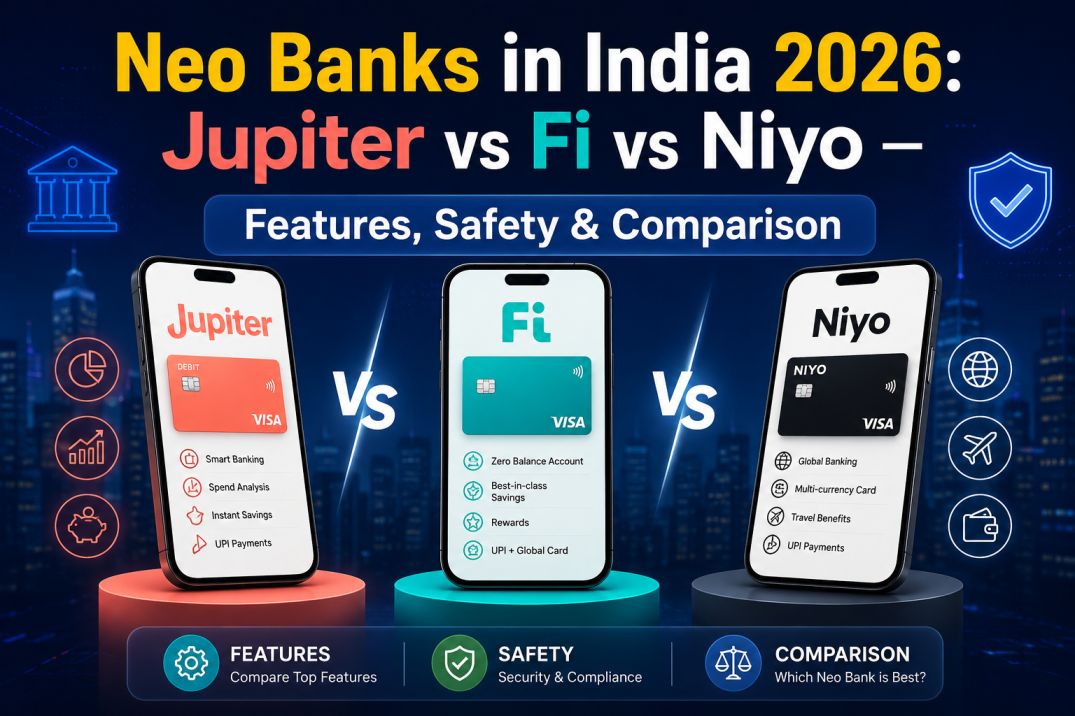
Neo Banks in India 2026: Jupiter vs Fi vs Niyo – Features, Safety & Comparison
Banking in India has changed significantly with the growth of mobile apps, UPI, digital KYC and fintech platforms. One popular term in this space is Neo Bank. But there is an important point that many users miss: in India, most platforms called “neo banks” are not banks themselves. They generally provide the technology, app experience and financial tools while regulated banks provide the actual banking account or card.

Three names that many Indian users associate with digital banking are Jupiter, Fi and Niyo. However, their current products and positioning are not identical. Therefore, users should compare the actual service, partner bank, charges and current availability instead of choosing an app simply because it is called a neo bank.
Important: Jupiter, Fi and Niyo should not be treated as traditional banks in the same way as an RBI-licensed commercial bank. The banking relationship depends on the regulated partner bank and the specific product you use.What Is a Neo Bank?
A neo bank is generally a digital-first financial service that focuses on providing banking and money-management services through an app rather than through traditional branches. Features can include digital account management, UPI payments, debit cards, expense tracking, savings tools, investments, loans and international payments.
The most important thing to understand is that the app and the bank can be different entities. For example, Jupiter states that it is not a bank and provides savings accounts through an RBI-licensed partner bank. Fi also states that it is not a bank and has historically provided its savings account through Federal Bank. Niyo similarly states that it is not a bank and that its savings accounts and cards are issued by partner banks.
Jupiter vs Fi vs Niyo: Quick Comparison
Platform Main Focus Banking Model Useful For Jupiter Money management, UPI, savings, rewards Partner-bank based Everyday digital money management Fi Money management, savings and investments Federal Bank partnership Existing users and financial tracking Niyo International spending and travel-focused banking Partner-bank based International travel and forex savings 1. Jupiter – Digital Money Management
Jupiter is positioned as a digital money-management platform. Its current offering includes UPI payments, savings accounts, debit cards, spending insights, “Pots” for setting aside money and various financial products. Jupiter also allows users to connect external bank accounts so they can view balances and transactions in one place.
One useful feature is Pots, which can be used to separate money for goals such as travel, emergencies or planned expenses. Jupiter also has a rewards system called “Jewels”, although the actual reward rate and redemption options can vary by product and transaction.
Jupiter’s biggest advantage is therefore not simply “having a bank account”; it is the combination of payments, money tracking, savings and financial tools inside one app.
2. Fi – What Has Changed in 2026?
Fi is especially important to discuss carefully because its service has changed. Fi’s current official website says that new savings accounts cannot currently be opened through the Fi app. Existing users are directed to use the FedMobile app as part of the banking-services transition.
Fi is not a bank. Its banking relationship has been associated with Federal Bank. Fi’s platform has offered features around savings, deposits, financial tracking, investments and international payments.
This is a good example of why users should check the current official terms and availability before opening or transferring money to any fintech platform. An article written two or three years ago may describe a product that is no longer available in exactly the same form.
3. Niyo – Particularly Useful for International Travel
Niyo has a different strength compared with Jupiter and Fi. Its current product lineup has a strong focus on international travel, forex cards and overseas spending.
Niyo states that it is not a bank and that its savings accounts, deposits and co-branded cards are issued through partner banks including DCB Bank and SBM Bank (India), depending on the product. Niyo’s current zero-forex products are designed for international transactions and can support spending across many countries.
However, “zero forex markup” does not mean that every possible overseas cost is automatically zero. ATM operators, taxes, card-specific charges, exchange-rate mechanics and other applicable fees can still matter. Users should therefore check the latest Schedule of Charges before travelling.
Which One Is Better?
Your Requirement More Relevant Option Daily UPI + money tracking Jupiter Existing Fi user / financial tracking Fi International travel Niyo Rewards and digital money tools Jupiter Are Neo Banks Safe in India?
Safety should be judged by the regulated bank behind the specific financial product, not simply by the fintech app’s brand name. If a savings account is actually maintained with a regulated bank, the applicable banking regulations and deposit-insurance framework depend on that bank and product.
For example, Fi states that eligible deposits with its banking partner Federal Bank are covered by the DICGC deposit-insurance framework up to the applicable limit. Niyo also states that funds in its relevant partner bank accounts are insured up to approved DICGC limits.
Still, users should never assume that every balance, investment, wallet, reward or financial product has identical protection. Deposit insurance is not the same thing as protection for investments or other financial products.
What Should You Check Before Using a Neo Bank?
- Check the actual partner bank behind the account.
- Read the latest fees and Schedule of Charges.
- Understand debit-card, ATM and international transaction charges.
- Check whether the account is currently available for new users.
- Do not select an account only because of cashback or rewards.
- Keep access to your primary bank account and do not put all your money into one fintech ecosystem.
Neo banking has made banking more convenient, especially for users who prefer mobile apps, UPI, digital cards, expense tracking and international payments. But Jupiter, Fi and Niyo are not interchangeable. Jupiter currently has a strong focus on everyday money management and rewards, Fi is undergoing an important banking-services transition, while Niyo is particularly attractive for users looking for international spending and zero-forex-focused products.
The smartest approach is to compare the specific product, partner bank, current availability, charges and your actual requirement rather than blindly choosing the most advertised app. Financial products can change, so always verify the latest terms on the provider’s official website before opening an account or moving significant money.
-

Child Education Planning: Build a Strong Financial Future for Your Child
Child Education Planning is one of the most important parts of financial planning for parents. As the cost of higher education continues to rise, starting an education fund early can help parents prepare for future expenses without creating unnecessary financial pressure.

A well-planned child education fund can help you manage future tuition fees, accommodation, books, professional courses and other education-related expenses. The earlier you start, the more time you have to build your financial goal.
What Is Child Education Planning?
Child Education Planning is the process of estimating your child’s future education expenses and creating a systematic financial strategy to meet those expenses. It involves setting a financial goal, estimating future costs, saving or investing regularly and reviewing the plan over time.
Instead of waiting until your child is ready for college, parents can start building an education savings plan years in advance. This can make the required monthly contribution more manageable.
Why Is Child Education Planning Important?
Education is a long-term financial goal. Depending on the course and institution, higher education can require a substantial amount of money. Proper financial planning for child education helps parents prepare for these expenses instead of arranging a large amount at the last moment.
- Helps create a dedicated education fund.
- Provides more time to save and invest.
- Helps manage increasing education costs.
- Can reduce dependence on sudden borrowing.
- Creates better financial discipline.
- Allows parents to plan other financial goals simultaneously.
Start Child Education Planning Early
One of the most important principles of child future planning is starting early. When you have many years before the education expense arrives, you have more time to build the required corpus through regular savings and investments.
Starting late may require significantly higher monthly contributions because there is less time available to accumulate the target amount. Therefore, even a small beginning can be useful when it is maintained consistently over the long term.
Estimate Your Child’s Future Education Cost
A common mistake in education financial planning is to calculate the education fund using today’s fees. Education expenses may increase over the years, so parents should consider the potential effect of inflation.
A simple way to understand future cost is:
Future Education Cost = Current Cost × (1 + Inflation Rate)ⁿHere, n represents the number of years until the money is required. This calculation is only an estimate, but it can help parents avoid setting an unrealistically low education fund target.
Set a Clear Education Financial Goal
A successful child education investment plan starts with a clear goal. Think about the type of education you may want to support and the possible costs involved.
Your planning may include:
- School and higher secondary education
- Undergraduate education
- Professional courses
- Postgraduate education
- Education outside your home city
- Potential international education
- Accommodation and other education-related expenses
Create a Dedicated Child Education Fund
Keeping your child education savings separate from your regular household savings can make it easier to track your progress. A dedicated goal-based fund also helps reduce the temptation to use the money for unnecessary expenses.
Regularly monitor how much you have accumulated and compare it with your expected future requirement. If there is a gap, you can increase your savings or adjust your financial strategy.
Choose Investments According to Your Time Horizon
There is no single investment option that is suitable for every parent. The right approach depends on your financial goals, investment time horizon, risk tolerance, income and other financial responsibilities.
For long-term goals, some investors may consider growth-oriented investments, while money needed in the near future may require a more conservative approach. The important point is to understand the risks before choosing any investment.
Increase Your Education Savings Over Time
Your income may increase as your career progresses. When your income rises, consider increasing your contribution toward the child education fund.
Even a gradual increase in monthly savings can make a meaningful difference over a long investment period. This approach can help your education planning keep pace with increasing expenses.
Do Not Ignore Your Retirement Planning
While planning your child’s future, it is equally important to maintain your own retirement planning. Using all available savings for education without considering retirement can create financial difficulties later in life.
A balanced financial plan should ideally consider both the child education fund and your long-term retirement needs.
Maintain an Emergency Fund
An emergency fund can protect your long-term financial goals from unexpected expenses. Job changes, emergencies or major household expenses can otherwise force families to withdraw money from investments intended for education.
Maintaining an appropriate emergency reserve can provide an additional layer of financial security while you continue working toward your child’s education goal.
Protect Your Child Education Plan
Child future financial planning should also consider what could happen if the primary income earner is unable to continue earning. Appropriate insurance and financial protection can help reduce the impact of unexpected events on the family’s long-term goals.
Review Your Child Education Plan Regularly
A financial plan should not be treated as a one-time activity. Review your child education investment plan periodically and make adjustments when your income, expenses, education goals or expected costs change.
Regular reviews can help you identify whether you are on track to achieve your education fund target or whether your monthly contribution needs to be increased.
Common Mistakes in Child Education Planning
- Starting too late: Delaying your education savings can increase the amount you need to contribute later.
- Ignoring inflation: Today’s education cost may not represent the actual cost when your child enters higher education.
- Choosing investments only for high returns: Higher potential returns can also involve higher risk.
- Having no target: Saving without a clear financial goal makes it difficult to measure progress.
- Using the education fund unnecessarily: Goal-based savings should be protected whenever possible.
- Ignoring retirement: Your child’s education should be planned alongside your own long-term financial security.
Simple Child Education Planning Strategy
1. Define your child’s education goal.
2. Estimate the current education cost.
3. Consider future cost increases.
4. Set a realistic education fund target.
5. Decide how much you can save regularly.
6. Select investments according to your time horizon and risk.
7. Increase contributions as your income grows.
8. Review the plan regularly.
Child Education Planning is not about predicting exactly what your child will become. It is about preparing financially so that your child has greater freedom to pursue educational opportunities in the future.
Starting early, estimating future education costs, investing consistently, maintaining financial protection and reviewing your strategy regularly can create a stronger foundation for your child’s future.
The most important step is simply to begin. A realistic financial plan started early can be more effective than a perfect plan that is postponed for years.
Disclaimer: This article is intended for general educational purposes only and should not be considered personalized financial or investment advice. Investment decisions should be made after considering your individual financial circumstances, goals and risk tolerance. -

Fintech Gold SIP – How to Start Gold SIP Online in 2026
Gold has been a familiar part of Indian households for generations. Earlier, buying gold usually meant purchasing jewellery, coins or bars from a physical store. Today, technology has changed the way people can access gold, allowing investors to explore online and app-based options.

One term that has become popular in this space is Gold SIP. The basic idea is simple: instead of making one large purchase, a person invests a fixed amount regularly according to the rules of the selected product or platform.
But there is an important point that every investor should understand: a Gold SIP is not automatically the same as a mutual fund SIP. Different platforms can use the term “Gold SIP” for different types of gold products.
Important: Before starting a Gold SIP, understand exactly what you are buying, who provides the product, how the underlying gold is held, what charges apply and what regulatory framework covers it.What Is Gold SIP?
Gold SIP generally means purchasing gold at regular intervals instead of investing a large amount at one time. Depending on the platform, an investor may be able to set up recurring purchases of digital gold or invest regularly through another gold-related financial product.
For example, a person may decide to invest ₹1,000 every month. The amount may be used to purchase a quantity of gold based on the applicable price and platform terms.
When the gold price is higher, the same investment amount may buy a smaller quantity. When the price is lower, it may buy a larger quantity.
Feature Gold SIP Investment style Regular gold purchases or investments Investment amount Depends on the selected product or platform Frequency Monthly or another recurring schedule Price risk Gold prices can rise or fall How Does Monthly Gold Investment Work?
The concept behind monthly gold investment is similar to the broader idea of investing a fixed amount regularly. Instead of trying to decide when the perfect time to buy gold will arrive, the investor follows a predefined schedule.
Suppose an investor chooses to invest ₹2,000 every month. The investor contributes the same amount each month, while the quantity of gold purchased can vary depending on the applicable gold price.
This approach can make investing more systematic, but it does not guarantee profits. Gold remains a market-linked asset and its value can move in either direction.
Key Point: Regular investing can provide discipline, but it does not remove market risk. A Gold SIP should never be presented as a guaranteed-return investment.How to Start Gold SIP Online
Starting a Gold SIP online can be convenient, but the exact process will depend on the product and provider you choose.
- Understand the product: First identify whether you are buying digital gold, a Gold ETF, a gold mutual fund or another gold-related product.
- Research the provider: Check the company or entity offering the product and understand its terms.
- Complete required verification: Depending on the product, KYC and other verification requirements may apply.
- Choose an amount: Select a monthly amount that fits comfortably into your budget.
- Check all costs: Look at applicable taxes, spreads, platform fees, storage-related costs, delivery charges and other expenses.
- Set up recurring investment: If the product supports recurring purchases, follow the platform’s instructions to activate the schedule.
- Review regularly: Monitor your holdings, transactions, charges and overall financial plan.
Digital Gold vs Gold ETF vs Gold Mutual Fund
This is one of the most important parts of understanding a fintech gold plan. Products that appear similar from the user’s perspective can have very different structures.
Product What It Means What to Check Digital Gold Online purchase representing gold held under the provider’s arrangement Provider, custody, terms, charges and regulatory framework Gold ETF Exchange-traded product designed to track gold prices Brokerage, expense ratio, liquidity and market costs Gold Mutual Fund Mutual fund route that invests through gold-related funds or ETFs Scheme structure, expenses, taxation and fund documents Is Gold SIP Safe?
The convenience of buying gold through a mobile application does not mean that the investment is risk-free. Investors need to understand both the market risk and the structure of the product they are purchasing.
In November 2025, the Securities and Exchange Board of India (SEBI) issued a public caution concerning dealing in digital gold. SEBI stated that digital gold products offered through certain online platforms fall outside its regulatory purview and do not have the investor protections associated with SEBI-regulated securities.
You can read the official SEBI communication here:
Read SEBI’s Official Caution on Digital Gold
Important Investor Alert: Do not assume that every product advertised as “Gold SIP” or “Digital Gold” is regulated in the same way as a Gold ETF or a mutual fund. Always check the actual product structure and applicable regulatory framework.What Should You Check Before Choosing a Fintech Gold Plan?
The biggest advantage of a fintech platform is convenience, but convenience should not be the only factor behind an investment decision.
Check This Why It Matters Provider You should know which entity actually provides the product. Gold custody Understand where and how the underlying gold is held. Buy and sell price The price at which you buy may differ from the price at which you sell. Charges Taxes, spreads and other fees can affect your effective return. Redemption Check whether physical delivery is available and what conditions apply. Regulatory status Understand which regulator, if any, oversees the specific product. Benefits of Gold SIP
- Regular investing: A fixed schedule can make investing more disciplined.
- Small investments: Some platforms allow users to start with relatively small amounts, subject to their minimum investment rules.
- Online convenience: Buying and monitoring holdings can be done digitally.
- Easy tracking: Digital platforms can provide transaction and holding information in one place.
- Diversification: Gold can play a role in a diversified portfolio, depending on an investor’s individual financial strategy.
Risks and Limitations of Gold SIP
While monthly gold investment can be convenient, it is important to understand that gold is not a guaranteed-return asset.
- Gold prices can fall as well as rise.
- The buying price and selling price may differ.
- Taxes and other charges can reduce the effective return.
- Different digital gold products can have different regulatory structures.
- Provider and custody arrangements should be understood before investing.
- Historical gold performance does not guarantee future returns.
How Much Should You Invest in Gold SIP?
There is no single monthly amount that is suitable for every investor. The right amount depends on your income, expenses, emergency savings, existing investments, debt and financial goals.
Instead of asking how much you can invest at the maximum, consider asking: “How much can I invest regularly without disturbing my important financial responsibilities?”
Smart Approach: Gold should generally be considered as part of a broader financial plan rather than automatically becoming the entire investment portfolio.Gold SIP Example
Let’s take a simple example. Suppose an investor decides to invest ₹1,500 every month for 12 months.
Monthly Investment 12-Month Contribution Possible Variables ₹1,500 ₹18,000 Gold price, quantity purchased, taxes and applicable charges Note: This example only demonstrates regular contributions. It does not represent expected returns or a recommendation to invest.
Gold SIP vs Gold Jewellery
Factor Gold SIP / Digital Gold Gold Jewellery Purchase method Online Usually physical purchase Storage Held under the applicable digital arrangement Physical storage required Use Primarily investment/holding depending on product Investment plus personal use Additional costs Depends on the product and platform Jewellery may involve making-related costs and other charges Frequently Asked Questions About Gold SIP
Is Gold SIP the same as SIP in a mutual fund?
No. SIP is a method of investing regularly. The underlying product can be different. A recurring digital-gold purchase is not the same product as a SIP into a gold mutual fund.
Can I start a Gold SIP with a small amount?
Some platforms support small recurring purchases, but the minimum investment amount and conditions depend on the particular provider and product.
Does Gold SIP guarantee profit?
No. Gold prices can increase or decrease. A regular investment strategy does not guarantee a positive return.
Is digital gold regulated by SEBI?
Not every digital gold product is a SEBI-regulated security. SEBI issued a public caution in November 2025 regarding digital gold offered through certain online platforms. Investors should therefore check the exact product structure and regulatory framework before investing.
For investor education and official information, visit: SEBI Investor
Fintech Gold SIP combines a traditional asset with modern digital technology. For investors who prefer regular investing, online platforms can make gold purchases more convenient and easier to track.
However, convenience should never replace research. Before starting a Gold SIP, understand exactly what you are purchasing, who is providing it, how the underlying gold is held, what charges apply, how redemption works and what regulatory framework applies.
Gold can have a place in a diversified financial strategy, but it should not automatically be treated as a guaranteed wealth-building solution. Your investment decisions should match your own financial goals, risk tolerance and overall financial situation.
Gold SIP Quick Checklist
- Understand the exact product before investing.
- Check the provider and gold custody arrangement.
- Compare buying and selling prices.
- Check taxes, spreads and other applicable charges.
- Understand redemption and withdrawal conditions.
- Check the applicable regulatory framework.
- Invest only an amount that fits your financial plan.
This article is provided for general educational and informational purposes only. It is not investment advice or a recommendation to buy digital gold, Gold ETFs, mutual funds or any other financial product. Gold prices can fluctuate and different products may have different risks, costs, taxation and regulatory structures. Always read the latest product documents and terms before investing. -

Gold ETF vs Physical Gold: Cost, Safety & Returns in India
Gold has always been considered an important asset for Indian investors. But today, you do not necessarily need to buy coins or jewellery to invest in gold. With a Gold ETF India option, investors can buy and sell gold exposure through a Demat account using online trading platforms.
So, which is better: physical gold or ETF? The answer depends on your purpose, investment amount, liquidity requirements and how you want to store your gold. Let’s compare both options in a simple and practical way.
Important: Gold should generally be viewed as a portfolio diversification asset rather than a guaranteed-return investment. Gold prices can rise or fall depending on market conditions.What Is a Gold ETF?
A Gold ETF (Exchange Traded Fund) is a market-linked investment product designed to provide exposure to gold prices. It is traded on a stock exchange, so investors generally need a Demat and trading account to buy and sell it.
Instead of keeping gold at home, you hold units of the ETF in your Demat account. You can place buy or sell orders through an online trading app during market hours. This makes Gold ETF India an attractive option for investors who want a digital way to gain exposure to gold.
Physical Gold vs ETF: Quick Comparison
Factor Physical Gold Gold ETF Storage Home locker or bank locker Held electronically in Demat Liquidity Depends on buyer/jeweller Can be traded on exchange Extra Costs Making charges may apply to jewellery Fund expenses and brokerage may apply Security Physical theft/loss risk Electronic holding Jewellery Use Yes No Cost: Which Option Can Be More Efficient?
Cost is one of the biggest differences between these options. When buying jewellery, the final price can include making charges, taxes and other applicable costs. These charges can reduce the amount of gold you effectively receive for your money.
Gold ETFs do not have jewellery-making charges. However, they are not completely free. Investors should consider the ETF’s expense ratio, brokerage, applicable taxes and the difference between buying and selling prices.
Simple rule: If your goal is investment rather than wearing jewellery, compare the total costs carefully before choosing physical gold or an ETF.Safety: Physical Gold vs Digital Holding
Physical gold needs secure storage. Keeping valuable gold at home creates a theft or loss risk, while a bank locker can involve an additional cost. Gold ETFs remove the need to physically store the metal yourself because your investment is held electronically.
However, electronic investments also have market and operational risks. Investors should use regulated platforms and understand the product before investing.
Returns: Is Gold ETF Better?
Neither physical gold nor a Gold ETF provides a fixed return. Their performance is primarily linked to movements in gold prices, although the actual investor experience can differ because of costs, premiums, discounts and other charges.
Illustrative example:
Suppose gold prices increase by 10% over a period. A Gold ETF may broadly track that movement, but expenses and trading costs can affect the investor’s actual return. Physical gold can also produce a different effective return because of purchase premiums, making charges and resale deductions.What About Gold Mutual Funds?
A gold mutual fund is another option for investors who prefer mutual-fund-based investing rather than directly trading an ETF. Gold mutual funds typically invest in Gold ETFs or related gold instruments and may allow investors to invest through systematic investment methods.
Before investing, check the fund’s expenses, investment structure, minimum investment requirements and taxation applicable to your situation.
Which One Should You Choose?
- Choose physical gold if you want jewellery or actual gold for personal or family use.
- Consider a Gold ETF if your main objective is investment, electronic holding and easier market-based buying and selling.
- Consider a gold mutual fund if you prefer the mutual fund route and want a simpler investment process.
Final Takeaway: There is no single winner in the physical gold vs ETF comparison. Physical gold is useful when you need the metal itself, while Gold ETFs can be more convenient for investors seeking market-linked gold exposure without personally storing physical gold. Compare costs, liquidity, risk and your investment objective before making a decision.Disclaimer: This article is for educational purposes only and should not be considered financial or investment advice. Gold prices can be volatile. Review the latest product documents, charges and applicable tax rules before investing.